
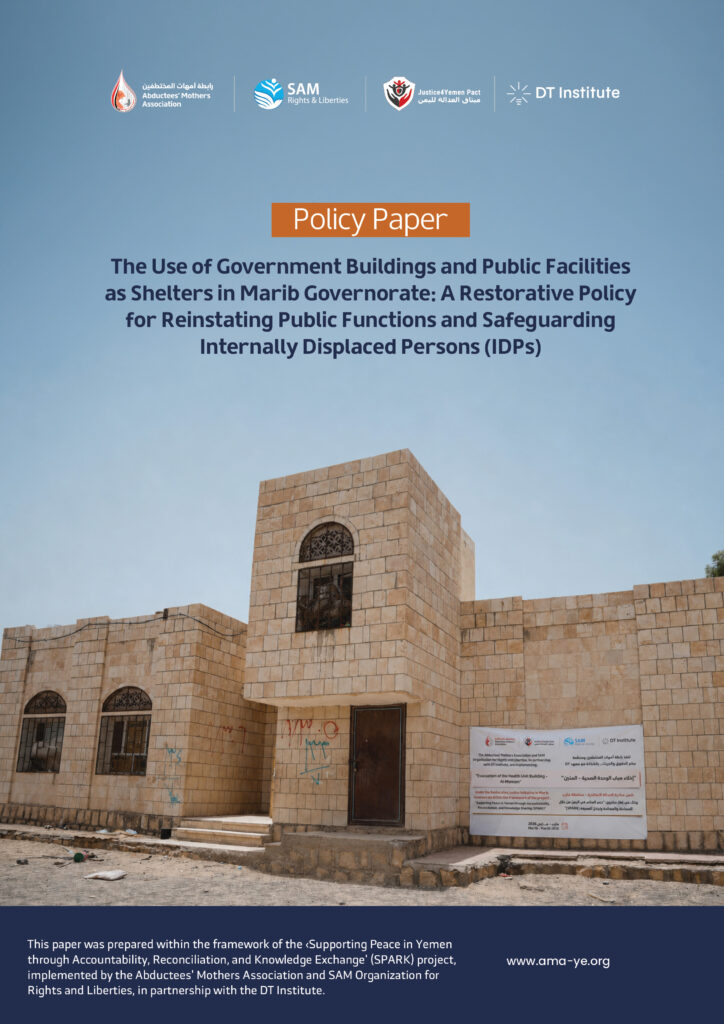
A new policy paper titled Occupation of Government Buildings and Public Facilities in Ma’rib Governorate: Towards a Restorative Policy for Restoring Public Functions and Protecting Displaced People” has been launched as part of the Support Peace in Yemen through Accountability, Reconciliation and Knowledge Sharing (SPARK) project, implemented by the Abductees’ Mothers Association in partnership with SAM for Rights and Liberties and with support from the DT Institute.
The paper examines one of the most pressing challenges resulting from years of conflict: the continued occupation of government buildings and public facilities to shelter internally displaced families, and the resulting impact on the continuity of public services, the performance of government institutions, the rights of displaced people, and social cohesion.
Drawing on a participatory methodology that included stakeholder dialogue sessions, qualitative interviews, and analysis of policy documents and practical experiences, the paper explores the underlying causes of the issue, assesses its consequences, and proposes a practical policy framework grounded in the principles of restorative justice. The proposed approach seeks to balance the restoration of government facilities to their intended public function with the protection of the rights and dignity of displaced families.
The paper also presents a set of policy recommendations and a phased implementation plan, alongside a case study documenting the successful restoration of a public facility through dialogue and coordination among relevant stakeholders. The experience highlights how collaborative, restorative approaches can strengthen trust, ensure the sustainable delivery of public services, and support broader peacebuilding and stability efforts.
The policy paper is available for download through the attached link.