
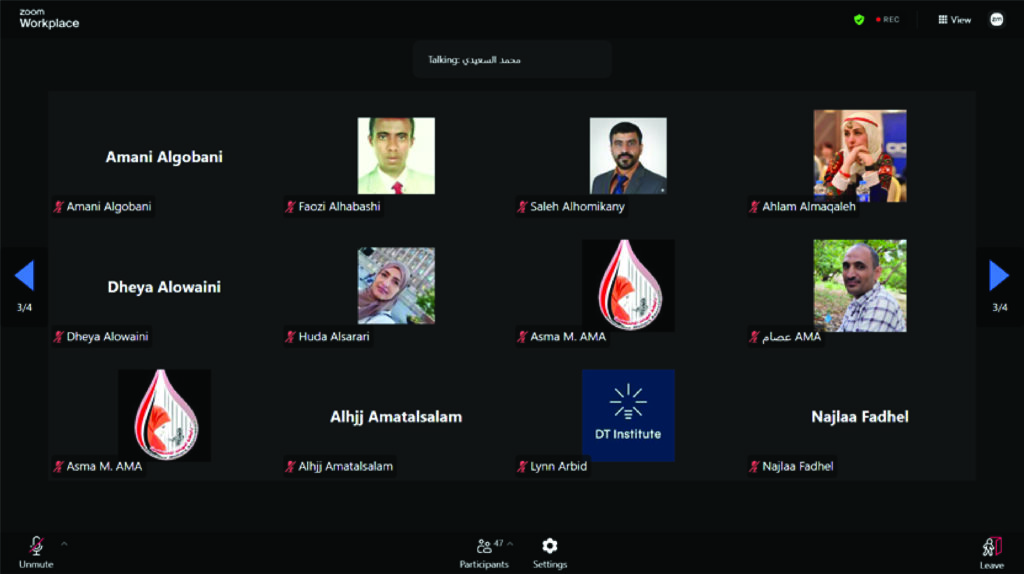
The Transitional Justice Ambassadors Forum, in coordination with the Abductees’ Mothers Association and funded by DT Institute, organized a virtual webinar titled “Justice of Tomorrow: A Reading of the Transitional Justice Draft Law and the Prospects for Documentation and Reconciliation in Yemen.” The event discussed the future of transitional justice in Yemen and ways to develop the draft law based on the outcomes of the National Dialogue Conference, in line with the political and human rights developments the country has witnessed in recent years, ensuring justice for victims and the achievement of sustainable peace.
The webinar featured former Minister of Legal Affairs Dr. Mohammed Al-Mikhlafi, current Minister of Legal Affairs Ishraq Al-Maqtari, and Chairperson of the Abductees’ Mothers Association Ms. Amat Al-Salam Al-Hajj, with the participation of academics, human rights defenders, and stakeholders in transitional justice and peacebuilding.
Dr. Mohammed Al-Mikhlafi stressed that the transitional justice law represents one of the key pillars of any transition toward peace and democracy, explaining that its philosophy is based on acknowledging past suffering, ensuring justice for victims, and preventing the recurrence of violations through mechanisms including truth-seeking, reparations, national reconciliation, and institutional reform. He added that the draft law sought to balance the requirements of justice and accountability on one hand with the need for national reconciliation on the other, contributing to ending cycles of revenge and building a future based on coexistence and social peace.
For her part, Minister Ishraq Al-Maqtari stated that the need for a transitional justice law has become more urgent than ever, in light of the war and widespread violations of multiple forms that the country has witnessed since 2014. She noted that the previously drafted law needs to be revisited and updated to align with current developments, pointing out that Yemen now has a broader base of documentation and monitoring, in addition to the growing role of civil society organizations and victims’ associations in documenting violations and defending the rights of those affected.
Al-Maqtari emphasized that peace should not be reduced to political agreements and power-sharing between conflict parties, stressing that transitional justice must be grounded in victims’ rights and ensure their meaningful participation in shaping the future, warning against any approaches that marginalize or bypass their demands. She also revealed that the Ministry of Legal Affairs has placed the reconsideration of the transitional justice draft law among its priorities, in response to growing demands from civil society organizations and victims’ groups.
In turn, the Chairperson of the Abductees’ Mothers Association, Uma Al-Salam Al-Hajj, affirmed that victims view transitional justice from a different perspective than other political actors, seeing it as a pathway to restoring human dignity and achieving justice for those affected. She explained that many victims continue to live with the daily consequences of violations, making it impossible to speak of reconciliation or forgiveness without truth-telling, accountability, and reparations.
Al-Hajj emphasized that women have played a central role throughout the years of war in defending rights, exposing violations, and demanding justice, noting that many have moved from traditional roles into active leadership and human rights positions. She called for ensuring the participation of women and victims in drafting laws and shaping transitional justice institutions, considering such inclusion a fundamental condition for the success of any peace or reconciliation process.
Participants highlighted the importance of preserving national memory and documenting violations as one of the key pillars of transitional justice. Al-Maqtari noted that recent years have seen extensive documentation and monitoring efforts by government bodies, civil society organizations, unions, and victims’ associations, contributing to an important database of evidence and information that can be relied upon in future truth-seeking and reparations processes.
In the same context, Ms. Amt Al-Salam Al-Hajj stressed the need to encourage victims to document and report their cases despite the security challenges and fears they face, affirming that preserving information and evidence today is a key safeguard for any future path toward justice and redress.
The webinar concluded by emphasizing that transitional justice is not merely a post-conflict option, but a process that must be prepared for now through documentation and preservation of national memory, expanding the participation of victims, women, and youth, and updating the draft law in a way that reflects Yemen’s current realities and lays the foundation for a just and sustainable peace based on truth, accountability, and non-impunity.