
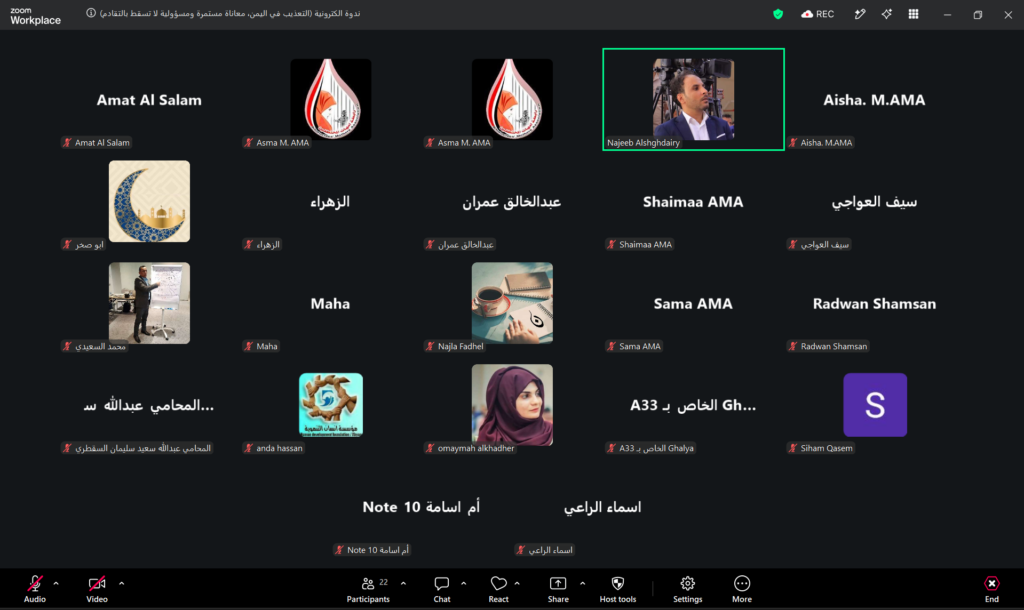
The Abductees’ Mothers Association held an online seminar last night titled “Torture in Yemen: Ongoing Suffering and a Responsibility That Does Not Expire”, as part of its advocacy campaign “No to Torture… Justice Is a Right for Victims”, launched to coincide with the International Day in Support of Victims of Torture.
The seminar opened with remarks from the head of the Abductees’ Mothers Association, Ms. Amat Al-Salam Al-Hajj, who welcomed participants and expressed appreciation for their engagement with the association’s activities. She called for broad participation in this international occasion, emphasizing that torture is not a fleeting violation but a crime that leaves deep and long-lasting consequences affecting victims and their families for years.
She stressed the need to sustain advocacy for the cause of abductees, amplify their voices and suffering to public opinion and relevant authorities, and exert pressure to stop torture, ill-treatment, and medical neglect. She also called for holding all those responsible to account and ensuring reparations for victims, so that such crimes remain present in collective human rights memory and their perpetrators do not escape justice.
Journalist Abdulkhaleq Imran shared his experience of torture, stressing that a victim’s suffering does not end upon release from prison. Instead, it continues in the form of physical, psychological, and social impacts borne by victims and their families for many years.
He noted that supporting torture survivors must begin immediately after release, through safe reception services, family reunification, comprehensive medical examinations, and the issuance of certified medical reports that can be used in transitional justice processes. He also emphasized the importance of documenting violations and collecting evidence to ensure that rights are not lost during legal proceedings.
He further called for a long-term national plan to rehabilitate victims psychologically, educationally, economically, and legally through a specialized national center, while empowering survivors to represent themselves in various forums as those best placed to convey their suffering and defend their rights.
For his part, journalist and human rights researcher Najeeb Shaghdar, who works with the National Commission to Investigate Alleged Violations of Human Rights and heads the Equality for Rights and Freedoms Organization, spoke about the role of civil society organizations in raising public awareness, pressuring relevant authorities to ensure justice for abductees, and documenting violations in ways that provide legal evidence for holding perpetrators accountable. He also highlighted their role in issuing recommendations that contribute to legislative development, enhanced civic participation, and influencing public policy.
Researcher and field monitor Aisha Al-Udaini from the Abductees’ Mothers Association presented aspects of her work documenting torture violations, noting that she has recorded 1,332 cases of torture and 88 deaths under torture. These figures are based on survivor testimonies, in-depth interviews, and statements from families and witnesses, collected through dedicated documentation forms for each case.
She emphasized that the association’s documentation methodology is based on verification of information and the construction of a reliable database that supports advocacy and transitional justice efforts, as well as exchange processes. She also stressed the prioritization of protecting the data of victims and witnesses, legal archiving, and documenting methods of torture in periodic reports.
At the conclusion of the seminar, participants issued a number of recommendations, most notably: exerting pressure on all parties to the conflict to release abductees, detainees, and forcibly disappeared persons; conducting independent and transparent investigations into all cases of torture and deaths in custody; and including accountability and anti-impunity measures in any future political settlement.
They also recommended obligating detention authorities to guarantee detainees’ rights under national constitutions and international humanitarian law; separating the file of civilian abductees from that of prisoners of armed conflict and releasing civilians unconditionally; ensuring the immediate release of abducted women; strengthening protections for human rights defenders; and establishing independent international mechanisms to investigate serious violations.